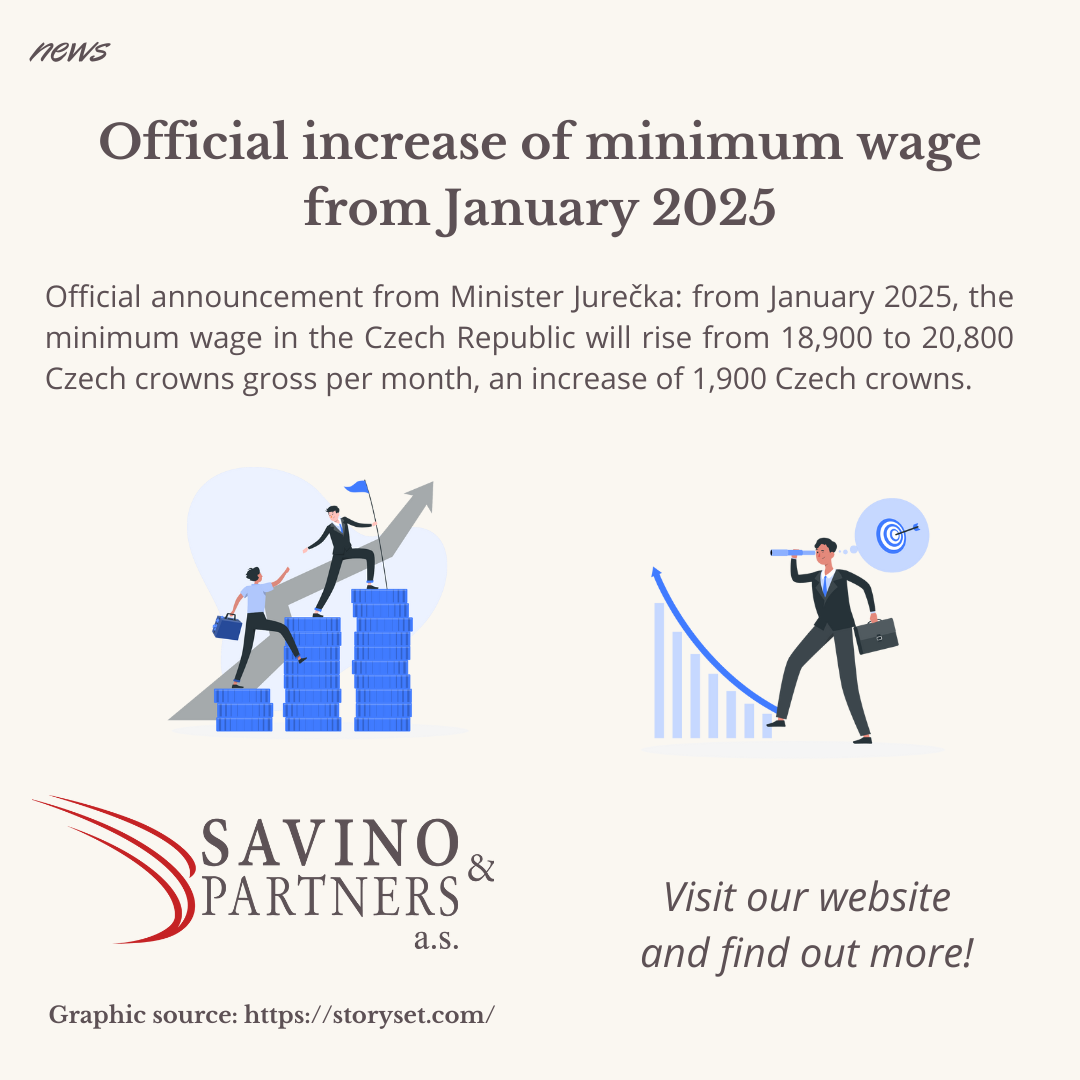
From January 2025, the minimum wage in the Czech Republic will officially increase by 1.900 crowns, from 18.900 to 20.800 crowns gross per month, according to Minister of Labour and Social Affairs Marian Jurečka (KDU-ČSL).
The feeling of a possible rise had already been circulating in August, when the proposal of a minimum wage of 20.600 Czech crowns was submitted to the interministerial consultation process. This change will have a significant impact on the Czech labour market, affecting the wages of an estimated 500,000 workers in the private sector, excluding the highest wage brackets.
With the government’s approval, the new minimum wage will allow workers to earn an additional 1.900 crowns per month. Minister of Labour Jurečka added that this change will help not only those who receive the minimum wage, but also those who receive guaranteed wages in the various levels of the wage system, concluding with the desire to reach a minimum wage of between 28.000 and 29.000 crowns gross by 2029, further influencing work in the Czech Republic and wage conditions in the long term.
For the first time, the increase is not the result of negotiations between the social parties, but rather the result of the semi-automatic mechanism approved by the current Parliament. For the private sector, the law abolishes the eight-tier guaranteed salary system, which varied according to competence and responsibility. Instead, a simplified four-tier system with a maximum wage of 1,6 times the minimum wage remains in place for the public sector.
Nevertheless, companies operating in the Czech Republic, especially those in low-margin sectors, are concerned that the increase in the minimum wage will have a negative impact on their operating costs and reduce their competitiveness. Business associations have expressed concern that many small and medium-sized enterprises (SMEs) may find it difficult to sustain this increase without a corresponding increase in productivity. This may have consequences on employment in the Czech Republic, with a possible reduction of employment or the necessity to increase the prices of goods and services to compensate for increased costs.
Businesses continue to attentively monitor developments and many of them are asking the government to introduce compensatory measures, such as tax incentives or subsidies, to alleviate the impact of the minimum wage increase on their operations.
Sources: https://ct24.ceskatelevize.cz/clanek/domaci/minimalni-mzda-se-pristi-rok-zvysi-o-1900-korun-rekl-jurecka-352577 https://www.camic.cz/it/news/lo-stipendio-minimo-aumentera-a-20-800-corone-ceche/
Visuals: www.storyset.com
Image generated by AI.