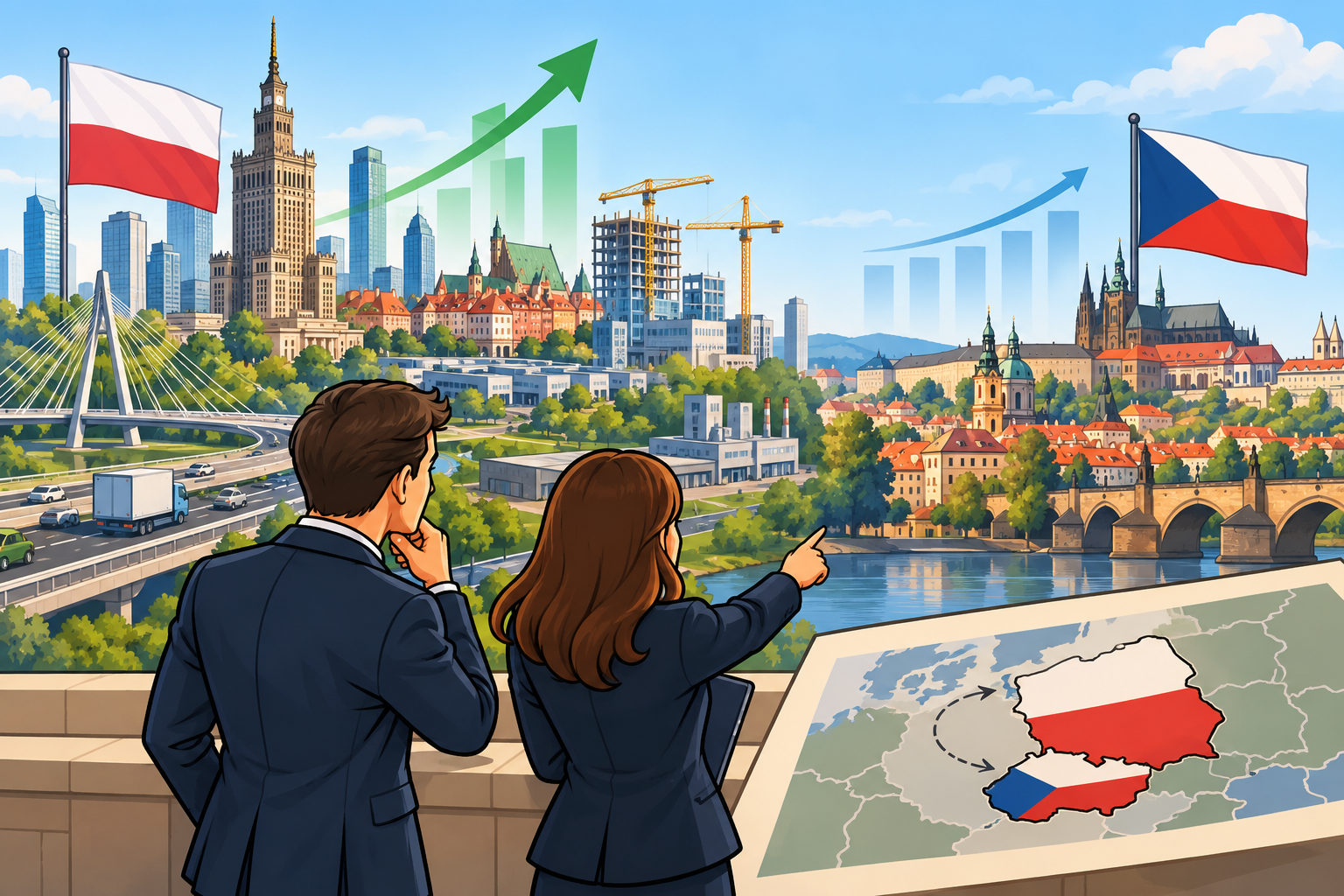
Poland’s Economic Growth and Different Development Strategies
Why do some European economies grow faster than others?
Poland economic growth offers an interesting case for understanding the changes taking place in Central Europe. Poland has supported its economy through public investment, infrastructure projects and industrial development.
An analysis published by E15 on 3 October looks at this development in more detail. It also compares Poland with nearby economies.
The comparison with the Czech Republic is especially useful. The 2 countries are geographically close, but they have followed different economic strategies. Therefore, the Polish case helps show how policy choices can influence growth.
Public Investment Behind Poland’s Economic Growth
Investment has played an important role in Poland’s recent development. New transport networks, construction projects and industrial areas have changed many parts of the country.
Infrastructure and defence spending are also important parts of this strategy. However, some of this investment has required higher public spending and more debt.
As a result, Poland economic growth is closely linked to the way public resources are used. New roads and infrastructure can make trade easier. They can also attract new business activity.
Still, spending alone does not guarantee long-term growth. The quality of investment matters as much as the amount. Projects need to improve productivity and create lasting economic benefits.
Czech Economic Growth and the Productivity Challenge
The Czech Republic faces a different situation. According to the analysis, weak productivity growth remains one of its main economic challenges.
At the same time, the country has relatively low public debt. This gives the Czech Republic more room to act in the future.
However, fiscal stability is only one part of the picture. The key question is how available resources are used.
Investment can support growth when it removes barriers or improves productivity. For example, infrastructure, technology and higher-value activities can all strengthen the economy.
Therefore, the comparison with Poland is not simply about spending more. It is about deciding where investment can have the strongest long-term impact.
What Can the Czech Republic Learn from Poland?
The Polish case does not provide a model that should be copied directly. Each country has different economic needs and priorities.
Still, it offers an important lesson. Economic growth depends not only on how much a country invests, but also on where that money goes.
For the Czech Republic, productivity remains a key issue. Therefore, future economic policy may need to focus more on investments that improve efficiency and create added value.
In addition, long-term planning can help connect public spending with clear economic goals. This is where the Polish example becomes useful as a point of comparison.
Internationalisation and Understanding Central European Markets
Economic differences between neighbouring countries also matter for companies. Businesses planning international expansion need to understand how each market develops.
Poland and the Czech Republic may be close, but their economic conditions and priorities are not identical. Therefore, companies should assess each market separately before making investment decisions.
Businesses evaluating accounting, tax and corporate aspects of a project in the Czech Republic can contact Axevera.
For a broader perspective on other international markets, companies can also explore internationalisation opportunities with IC&Partners.
Overall, Poland economic growth shows how infrastructure, investment and productivity can shape a country’s development. For businesses, understanding these differences is also essential when choosing where and how to expand.
AI Image