
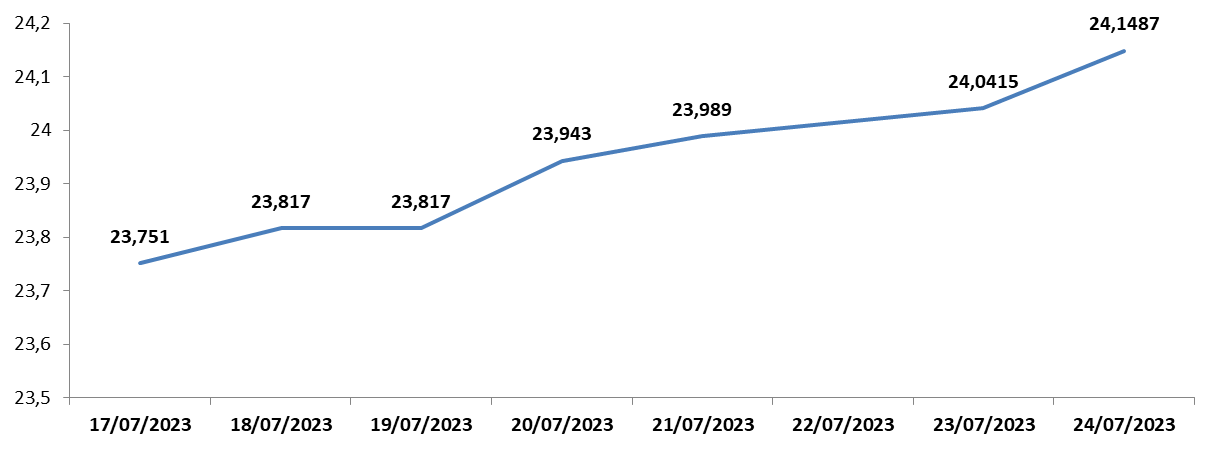
After a strong first half of the year, the Czech crown begins to weaken. On Friday, the exchange rate of the Czech currency surpassed the threshold of 24 CZK/euro for the first time since mid-March.
Causes of the decline
The crown reached its peak this year in April and May when it reached a level of 23.4 CZK/EUR. However, in recent weeks, it has started to weaken, and on Friday, it closed above the 24 CZK/EUR mark. On Saturday, it only slightly corrected the loss to 23.99 CZK/EUR. “The main reason for the fall of the crown is an increasingly evident change in expectations regarding the next interest rate fixation by the Czech National Bank. Central bankers have long kept the key rate at seven percent as part of the fight against high inflation. In recent months, however, it has been decreasing, and in June, it fell below the magical ten percent threshold. Inflation in the industry even dropped to 1.9% in the same month,” explained Citfin analyst Tomáš Volf. The mere fact that the Czech National Bank is starting to talk about rate reductions has had an effect on the currency. As soon as the bank begins to cut rates, the Czech crown will lose its appeal, and the exchange rate will continue its descent, which has only been hinted at for now. The graph shows the trend of the CZK/EUR exchange rate for the last week.
Explaining the mechanism
The macroeconomic mechanism behind the weakening of the Czech crown against the euro is a consequence of several dynamics. Individuals who expect lower interest rates in the future will be less inclined to buy government bonds since they will yield less for the same issuer’s risk. With less money flowing into the purchase of state bonds by foreign investors, there will be less demand for Czech crowns in exchange for euros, which affects the CZK/EUR exchange rate. The domestic currency, in this case, the Czech crown, suffers from the reduction of interest rates in the country where it is used as the official means of payment. Usually, the mechanism just explained has a delayed effect on the exchange rate, but at this moment, expectations play a key role and give a small preview of what might come.
Summing up, if interest rates decrease, state bonds become less appealing to foreign investors, leading to lower demand for Czech crowns to buy them, which reflects on the exchange rate, weakening the local currency with lower demand.
Further discussions on interest rates in August
In his comment, ČSOB analyst Dominik Rusinko pointed out that the market expects the Czech National Bank to reduce the basic interest rate by up to 100 basis points, or one percentage point, by the end of the year. According to him, the statements of central bankers also influenced the weakening of the crown. “First, there was Tomáš Holub, a longtime hawk within the board of the bank, who no longer sees room for higher rates. This week, Eva Zamrazilová emphasized that she expects a gradual weakening of the national currency to one crown per twelve months. For the markets, this could be a slightly accommodating surprise given the willingness to tolerate a weaker exchange rate compared to the current forecast of 24.40 EUR/CZK in the third quarter of next year,” said Rusinko. The Czech National Bank’s Monetary Board will discuss interest rate fixation at the meeting on August 3. “We believe that current bets on a decline in interest rates in the Czech Republic this year are exaggerated, which should partially alleviate the selling pressure on the crown in the future,” Rusinko added.
Sources: https://www.novinky.cz/
Image source: https://pixabay.com/
Graphics source: https://storyset.com/


