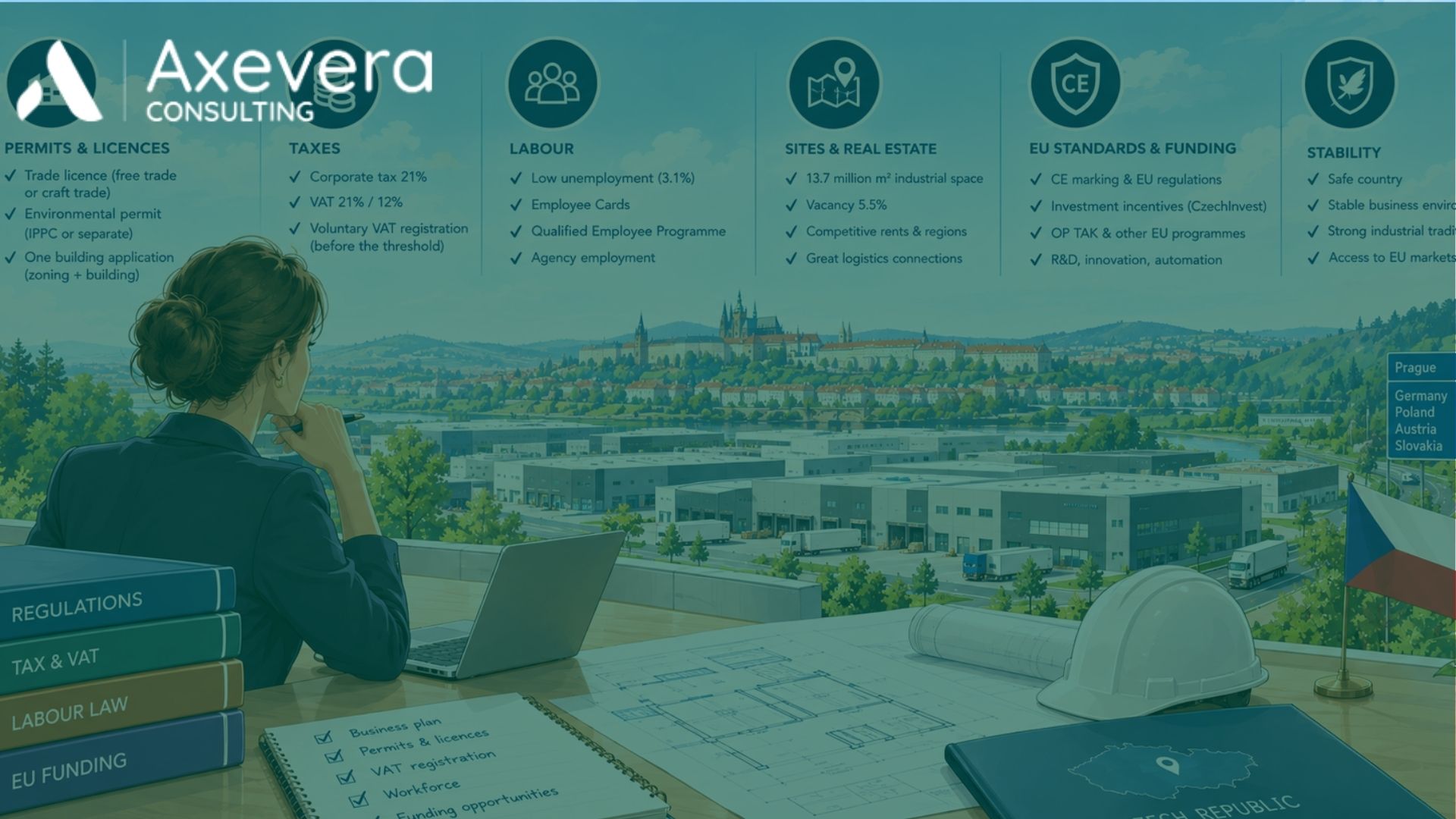
For a manufacturer, Czech market entry is not one procedure but several, and which one applies turns on a single question: what exactly comes off the line. Get that classification right and the rest is administratively undramatic – corporate tax a flat 21%, zoning and building merged into one permit, 13.7 million square metres of industrial space with vacancy finally moving in the tenant’s favour, motorway access to Germany, Poland, Austria and Slovakia. Get it wrong and you find the missing qualification, permit or environmental opinion after the site is signed.
Manufacturing in the Czech Republic entry here follows a standard sequence, and the sequence is the part worth publishing. What cannot be published is the branch a given company takes through it: licensing category, environmental threshold and qualification requirement all change with the activity, machining is not food processing, and neither is surface treatment. What follows is the standard route, with the forks marked.
Your Permit Path Depends on What You Make
The Trade Licensing Act (Act No. 455/1991 Coll.) sorts productive activities into four categories, and the difference is not cosmetic. Much light manufacturing and assembly is a free trade, registered on notification. Metalworking, machining, joinery, electrical work and food production are craft trades (Annex 1) and require a responsible representative with the relevant qualification and documented practice. A few activities are tied (Annex 2) or need a concession (Annex 3). The category decides whether the company starts next week or first has to find a qualified person.
The second fork is environmental. An installation listed in Annex 1 to Act No. 76/2002 Coll. – foundries, surface treatment above certain volumes, chemical production, larger food plants – run under an integrated permit (IPPC) that must be in hand before commissioning, not after. Below those thresholds, air, waste and water are handled separately. The threshold is set by what you make and how much of it.
Construction, by contrast, has gotten easier. Under the Building Act (Act No. 283/2021 Coll.), zoning and building are merged into one proceeding: the investor files a single application, and the building office gathers the official positions itself through one environmental opinion instead of leaving you to chase ten authorities. Deadlines are statutory; the procedure is digital. Which branch applies to your product is the first thing to establish, and the reason the procedure is standard while the file never is: Axevera’s legal and corporate consulting maps the classification, the permits and their order before a site or a machine is committed.
Sites and Warehouses Across the Country, Not Only Around Prague
Czech industrial stock reached 13.7 million square metres by mid-2026, and production – not logistics – took 39% of net take-up in the first half of the year. More useful for a newcomer: vacancy has risen to 5.5% with over a million square metres under construction, which makes this an occupier’s market for the first time in years.
The regional spread is where the money is made. Prime rents run about €7.25 per square metre a month in Prague and Central Bohemia and €7.00 in Brno, where vacancy is a punishing 1.7%; Pilsen sits at €5.75 with 8.3% vacancy, Ostrava at €6.00 with 15.6%. Pilsen is ninety minutes from Nuremberg on the D5, Ostrava on the Polish and Slovak borders at the end of the D1. For a plant serving southern Germany or a Silesian supply chain, Prague rents are a choice, not a necessity.
One advantage rarely priced into a feasibility study: Czech industry has traded eastward for decades and the commercial infrastructure survives – language skills, distribution contacts, freight-forwarding experience across Ukraine, the Caucasus and Central Asia. A Czech plant is a production base inside the single market and a sales platform for markets awkward to serve from Milan or Stuttgart.
Tax Certainty, and the VAT Question That Decides Your Cash Flow
Corporate income tax is 21% (§ 21, Act No. 586/1992 Coll.), national, with no regional or municipal surcharge and no IRAP-style parallel tax. VAT is 21% and 12% (Act No. 235/2004 Coll.). In a ten-year investment case that predictability beats a lower headline rate elsewhere.
What catches manufacturers is timing. Registration becomes compulsory only above CZK 2,000,000 of turnover in twelve months, but a plant under construction has no turnover and very large input VAT on land, hall, machinery and installation: waiting for the threshold means financing that VAT for a year. Voluntary registration under § 6f of the VAT Act is the way out, granted only against evidence of a real and imminent taxable activity, business plan, contracts, lease, orders. We prepare that reasoned application, one of the few filings where the argument changes the answer.
Labour Is the Real Constraint, and Banks Are the Second
Czech unemployment stood at 3.1% in December 2025 against an EU average of 5.9% – the lowest in the Union, which for an employer is a warning rather than a compliment. Industrial regions compete hard for welders, machine operators, maintenance technicians and shift supervisors.
Three legal routes exist and are normally combined. Employee Cards under Act No. 326/1999 Coll. cover individual third-country hires. The Government’s Qualified Employee Programme runs quota-based fast tracks for Ukraine, Serbia, the Philippines, India, Moldova, Georgia, Kazakhstan, Mongolia and others, with quotas raised and processing shortened for 2026. Agency employment under §§ 307a-309 of the Labour Code (Act No. 262/2006 Coll.) covers ramp-up, subject to the equal-treatment rule that agency staff cost what your own cost. We handle the rules and the filings and work with staffing agencies for interim capacity, the area where planning a year out pays best.
Banking belongs in the same timeline. The bank must document the ownership chain up to the beneficial owner and cross-check it against the national register; a holding structure two jurisdictions away produces questions, not a refusal. Prepared properly, account opening takes weeks. Improvised, it stalls a capital contribution and a machinery payment. Axevera’s administrative and secretarial support carries that relationship.
EU Rules, Standards and the Funding That Comes With Them
Everything made here is made inside the single market. CE marking and technical requirements follow the harmonised EU regulations, and Czech notified bodies can certify: a product compliant in Italy is compliant here, with no second national regime.
The same alignment opens the funding side. Investment incentives under Act No. 72/2000 Coll. – tax relief, job-creation and training grants, discounted land in industrial zones – plus Ministry of Industry schemes and EU operational programmes, available to the company’s Czech-based entity, have favoured higher value-added, R&D-linked and automation projects since the 2019 reform. Applications are specialist work, run with specialist partners rather than in-house, but the eligibility test belongs at the start: incentives are not granted retrospectively.
A Stable Place to Put Fixed Assets
A plant is a ten-year commitment, which makes stability part of the return. The Czech Republic consistently ranks among the ten most peaceful countries in the world in the Global Peace Index; industrial relations are pragmatic, and organised crime pressure on industrial sites is not a factor in security planning. None of this shows up in a feasibility study. All of it shows up in insurance premiums and downtime.
Conclusions
The Czech Republic is an easy country to manufacture in and an easy one to get wrong in the first sixty days. The sequence is standard: classify the activity, secure the qualification if the trade needs one, settle the environmental regime, file one building application, register for VAT before the threshold, plan the workforce a year ahead, prepare the bank. The branch through that sequence is specific to your product, and that is the part worth advice.
FAQ
Does my production activity need a qualified person?
It depends on the classification under Act No. 455/1991 Coll.: free trades do not; craft trades (Annex 1) require a responsible representative with the relevant qualification and practice.
When do I need an integrated (IPPC) permit?
When the installation appears in Annex 1 to Act No. 76/2002 Coll. – foundries, surface treatment above set volumes, chemical production, larger food plants. It must be in hand before commissioning.
How long does a permit for a production hall take?
Zoning and building are now one proceeding under Act No. 283/2021 Coll.: a single application, one environmental opinion and statutory deadlines for the authority.
Can I register for VAT before reaching the threshold?
Yes, voluntarily under § 6f of Act No. 235/2004 Coll. The tax office requires evidence of a real, imminent taxable activity, so the application has to be argued – which matters when input VAT on the investment is large.
How do I staff a plant in a 3% unemployment market?
By combining Employee Cards (Act No. 326/1999 Coll.), the Government’s Qualified Employee Programme quotas and agency employment under §§ 307a–309 of the Labour Code for ramp-up.
Does Axevera handle grant applications?
Investment incentives and EU programmes are run with specialist partners, not in-house. Axevera covers the corporate, licensing, tax, employment and banking side, and tests eligibility early.